EV Charger Installation Cost and Grants by Country
What a home EV charger costs installed, what changes the price on the day, and which grants are available in the UK, US, Canada and Australia.
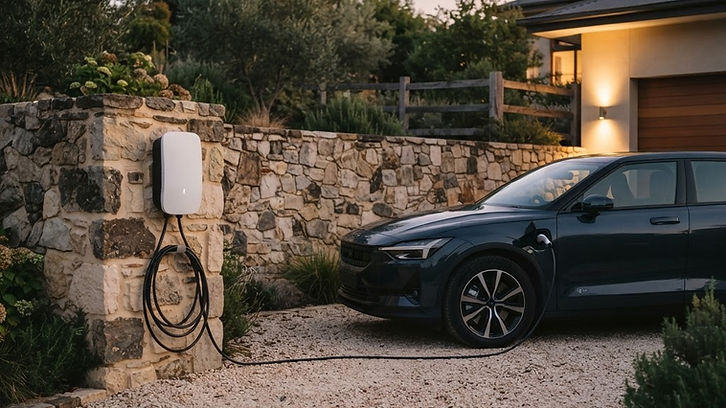
A home charger is the cheapest of the four upgrades in this directory, and the one with the fastest payback — mostly because public rapid charging is so expensive per mile by comparison.
Ranges are indicative for planning and exclude any grant. Confirm local pricing with an accredited installer.
What you are actually buying
- The charge point — typically a 7kW unit for single-phase homes, 11kW or 22kW for three-phase properties.
- The cable run from your consumer unit to the parking spot, which is where costs vary most.
- Protection and switching, including an RCD type A or B depending on the unit, and a dedicated circuit.
- Load balancing, so the charger does not trip your main fuse when the oven and heat pump are running.
- Certification and notification of the local distribution network where required.
Typical installed cost
- United Kingdom — from around £950 for a standard 7kW install with a short cable run.
- United States — from around $1,150, with wide variation for panel upgrades.
- Canada — from around C$1,350.
- Australia — from around A$1,450.
What pushes the price up
- Cable distance. A 25-metre run can double the labour and materials.
- Consumer unit upgrades. Older fuse boards often need replacing, and some need a separate garage sub-panel.
- Single versus three phase. Three-phase installs cost more but charge faster.
- Groundworks. A charger across a driveway or in a detached garage may need trenching.
- Older wiring. Aluminium wiring or no earth connection adds remedial work.
Grants and support
Support for home charging has narrowed in most markets to landlords, renters and specific regions, while some countries still offer a percentage of the purchase and installation cost for homeowners. In all four markets, the strongest financial case is not the grant but the tariff: a dedicated EV tariff can cut the cost per mile by 60–70% compared with standard rates.
Check current schemes before buying, and confirm the installer will submit the claim — most require an approved installer, not just an approved charger.
Charging speed in practice
A 7kW charger adds roughly 25–30 miles of range per hour. For most drivers that means a full overnight charge without any special planning. You do not need 22kW at home: very few cars accept it on AC, and the extra cost rarely earns anything back.
Making it cheaper to run
- Choose an EV-specific tariff with a cheap overnight window.
- Schedule charging in the car or the charger app rather than plugging in at 6pm.
- If you have solar, use a charger with solar diversion so surplus generation goes into the car rather than the grid.
- Keep the charger's load balancing enabled so you never need a supply upgrade.
What to ask an installer
- Will you do a site survey before quoting, or quote blind?
- Is the quote inclusive of the cable run, or per metre beyond a set length?
- Will you notify the network operator where required?
- Is the unit approved for any available grant?
- Does the unit support scheduled and solar-only charging?
Compare accredited EV charger installers: UK, US, Canada, Australia.
Frequently asked questions
Can I install an EV charger myself?
In almost every market, no. The work is notifiable electrical work that requires a certified electrician, and self-installation voids both the warranty and any grant.
Do I need three-phase power?
Only if you want faster AC charging or have a very large battery. A 7kW single-phase charger covers the vast majority of home needs.
How much does charging at home cost per mile?
On a cheap overnight tariff, typically a third to a quarter of the cost of public rapid charging, and far less than petrol or diesel per mile.