How Many Solar Panels Do I Need?
A sizing guide that starts from your actual electricity usage, not your roof, with worked examples for four typical households.
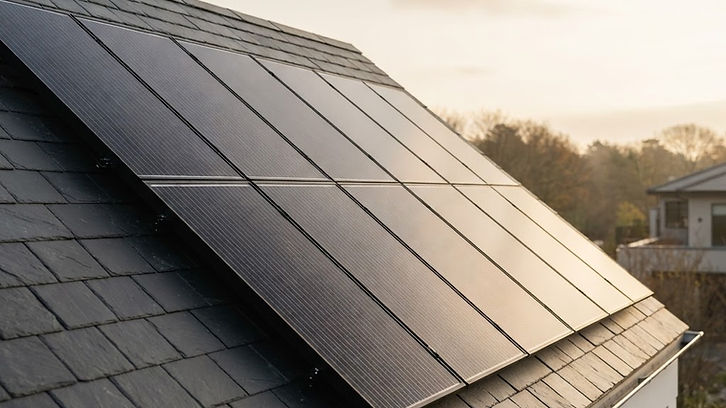
The right system size is a budget question dressed up as a roof question. Most homeowners ask how many panels fit; the more useful question is how many kilowatt-hours you actually consume, and how much of that you can realistically cover.
Start with usage, not roof area
Find a full year of electricity bills and add up the kilowatt-hours. A single month is misleading because heating and cooling swing the total.
If you are planning a heat pump or an EV, size for the future. An EV doing 12,000 miles a year adds roughly 3,000kWh. A heat pump replacing gas can add 2,500–4,000kWh of electricity demand.
The sizing formula
- Take annual consumption in kWh.
- Divide by your local specific yield — the kWh each installed kW generates per year.
- That gives the system size in kW.
- Divide by panel wattage to get the panel count.
Typical specific yields:
- Southern UK: 850–950 kWh per kW per year.
- Northern US and Canada: 1,100–1,300.
- California, Arizona, Texas: 1,500–1,700.
- Most of Australia: 1,400–1,700.
Worked examples
- Manchester, 3,800kWh a year, no EV. 3,800 ÷ 900 = 4.2kW, or about ten 420W panels.
- Austin, 11,000kWh a year with air conditioning. 11,000 ÷ 1,550 = 7.1kW, or seventeen 420W panels.
- Melbourne, 5,500kWh with a future EV. 5,500 ÷ 1,450 = 3.8kW today, but plan for 6.6kW to cover the car.
- Toronto, 9,000kWh with a heat pump. 9,000 ÷ 1,200 = 7.5kW, which usually needs a mix of roof planes.
Roof constraints that change the answer
- Usable area, not total area. Chimneys, skylights, vents and fire setbacks all subtract.
- Orientation. South-facing is ideal in the northern hemisphere; east and west still work well and spread generation across the day.
- Pitch. Steep roofs lose some winter output but shed snow.
- Shading. One shaded panel can drag down a whole string unless optimisers are fitted.
Should you size to 100% of usage?
Rarely. Covering your entire annual consumption looks good on paper, but much of that generation is exported at a low rate. Many households get a better return from a system covering 60–80% of usage plus behavioural changes — running the dishwasher and washing machine during the day, or adding a battery later.
Where export rates are generous, oversizing is more attractive. Where they are poor, self-consumption is everything.
A note on panel wattage
Residential panels now commonly sit between 400W and 450W. Higher wattage means fewer panels for the same capacity, which matters when roof space is tight — not otherwise. Panel quality and the inverter matter more than the headline wattage.
Get a roof-specific estimate from an accredited installer: UK, US, Canada, Australia.
Frequently asked questions
Is a bigger system always better value?
Per watt, usually yes. Per pound or dollar invested, no — the last panels in an oversized system may only ever produce exported power at a low rate.
Can I add panels later?
Often, if the inverter and roof layout allow it. Ask for a battery-ready hybrid inverter and leave physical space if you plan to expand.
Does a north-facing roof rule out solar?
No, but output drops substantially. It is usually only worth it when paired with a cheap installation and high electricity prices.
More solar guides

 Solar
Solar Incentives and Tax Credits: US, UK, Canada and Australia
How solar support works in each market, whether it is claimed at the point of sale or on a tax return, and the paperwork that protects your claim.
SolarSolar Panel Cost and Payback Period by Country
What a residential solar system costs in each market, how to calculate payback honestly, and why identical systems pay back at very different speeds.